
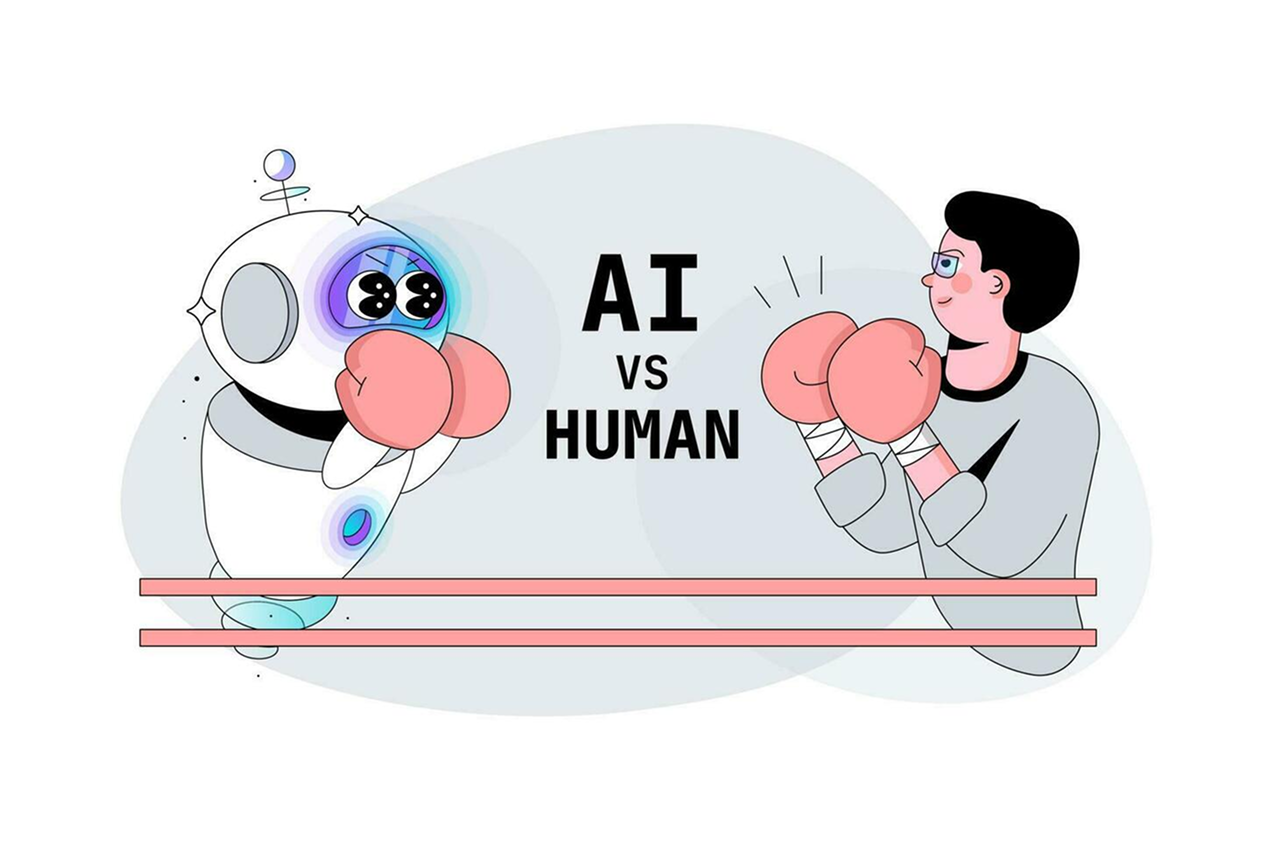
AI has advanced rapidly. It can beat world champions in chess and Go, create art, compose music, and even write blog posts. But can machines truly outperform humans in creativity, games, and problem-solving?
Creativity
AI tools like DALL·E, MidJourney, and ChatGPT can generate images, stories, and music by learning from massive datasets.
Strengths:
Fast and limitless variations
Imitates multiple styles
Helps brainstorm ideas
Limitations:
No personal emotion or experience
Can’t create truly original concepts

Games
AI excels in strategy-based games:
Chess: Deep Blue beat Kasparov
Go: AlphaGo beat Lee Sedol
Poker: AI can calculate probabilities and bluff
AI Strengths: fast calculations, continuous learning, no fatigue.
Human Edge: intuition, creativity, emotional reading, and adaptability.
Problem-Solving: Logic vs. Life Experience
Problem-solving goes far beyond games and art — it’s about tackling real-world challenges. AI excels when problems can be broken down into data-driven patterns, but humans bring something deeper.
AI’s Strengths in Problem-Solving:
Analyzes massive datasets to uncover hidden patterns.
Finds efficient solutions in logistics, finance, and medicine.
Handles repetitive, detail-oriented tasks with high accuracy.
Human Strengths in Problem-Solving:
Applies empathy, ethics, and human values to decisions.
Uses common sense and real-life experience in uncertain situations.
Balances logic with emotional and social understanding.
The Real Answer: Collaboration Wins
Instead of viewing AI vs. Humans as a competition, it’s more powerful to see it as a collaboration.
AI can analyze data, generate ideas, and speed up complex processes, while humans bring creativity, emotion, ethics, and purpose. When we work together, we can achieve far more than either could alone.
In the end, the future isn’t AI replacing humans — it’s AI empowering humans.